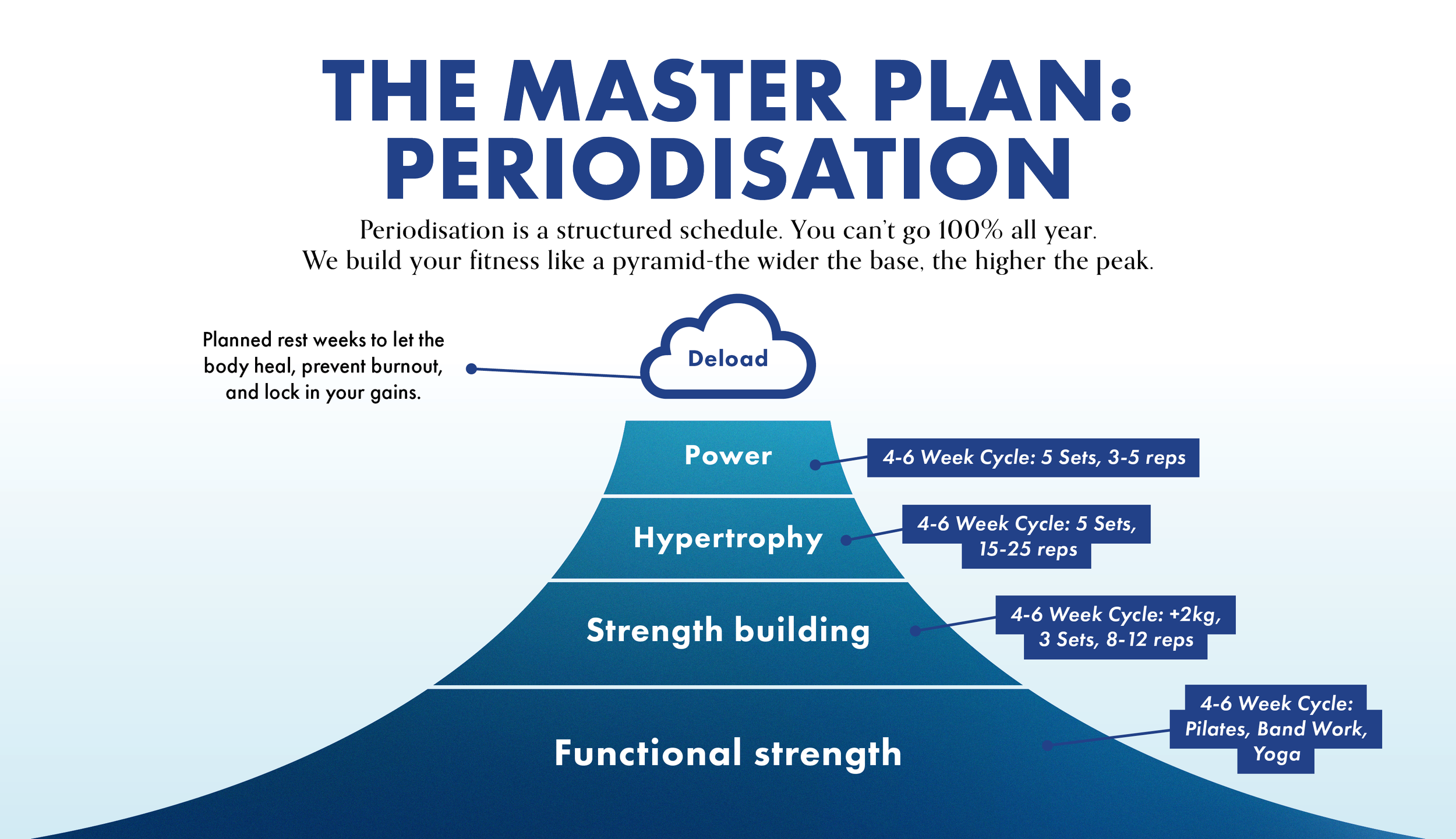
PERIODISATION
Build Performance, Avoid Plateaus and Reduce Injury Risk.
Periodisation is the structured planning of training over time to progressively build performance, avoid plateaus, and reduce injury risk. Instead of doing the same workouts year-round, training is broken into phases (“cycles”) with specific goals, allowing the body to adapt, recover, and peak at the right time.
In a clinical or general population setting, periodisation is less about “peaking” for performance and more about safely progressing capacity, improving function, and maintaining long-term engagement – making it a cornerstone of effective exercise prescription.
The Stages of Periodisation
1. Foundation Phase (Base)
Focus: Build general fitness, movement quality, and consistency
Training Style: Lower intensity, higher volume
Examples: Technique work, aerobic conditioning, light-moderate strength
Goal: Prepare the body for harder training
2. Build Phase (Progression)
Focus: Increase strength, capacity and workload
Training Style: Gradually increasing intensity and/or volume
Examples: Heavier resistance training, longer or more challenging sessions
Goal: Create progressive overload to drive adaptation
3. Peak Phase (Performance)
Focus: Maximise performance in a specific outcome (event, test or goal)
Training Style: High intensity, lower volume, more specificity
Examples: Max strength lifts, speed work, sport-specific drills
Goal: Reach optimal performance at the right time
4. Deload (Recovery Phase)
Focus: Reduce fatigue and allow recovery
Training Style: Reduced volume and/or intensity
Examples: Lighter sessions, mobility, active recovery
Goal: Prevent burnout, consolidate gains, and prepare for the next cycle